Did you know there are roughly 750 Covered Bridges in the US? That’s a lot right? And it turns out that Vermont is the state with the most covered bridges with a little over 100 of them. (Wow!) If you are a Covered Bridge Seeker then Vermont would be a great place to start your journey!
For me, Bennington Vermont was within a day trip, so we visited two bridges and drove by a third. (These bridges are all within 2 miles of each other.) After arriving in Bennington, we had lunch at Madison Brewing Company and then strolled around Main Street. Then we hopped in the car and visited Silk Road Covered Bridge, drove past Paper Mill Village Bridge and stopped again at Henry Covered Bridge. All three are listed on the National Historic Registry and are pinned on the map below using Orange pins.
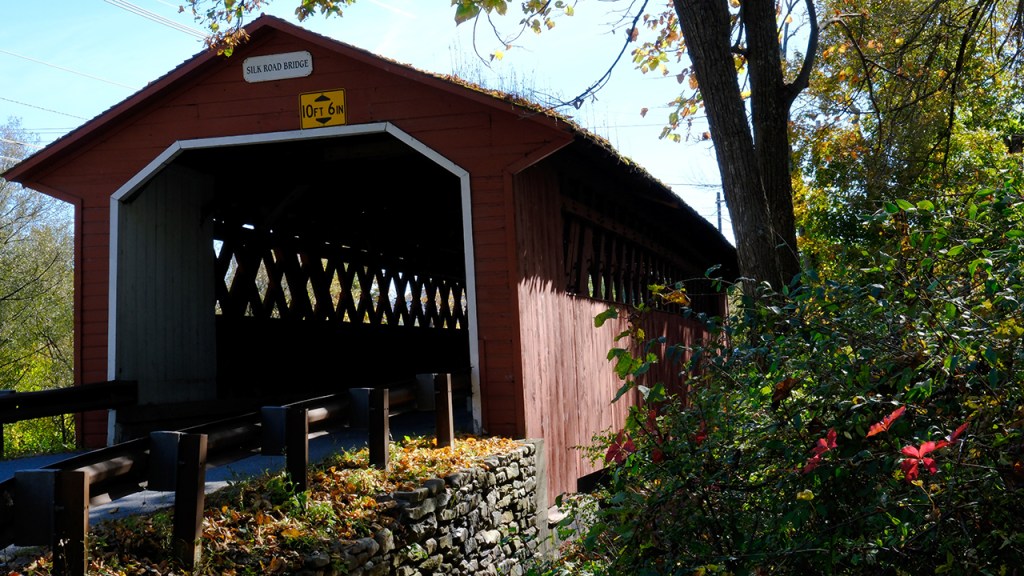
About Silk Road Covered Bridge
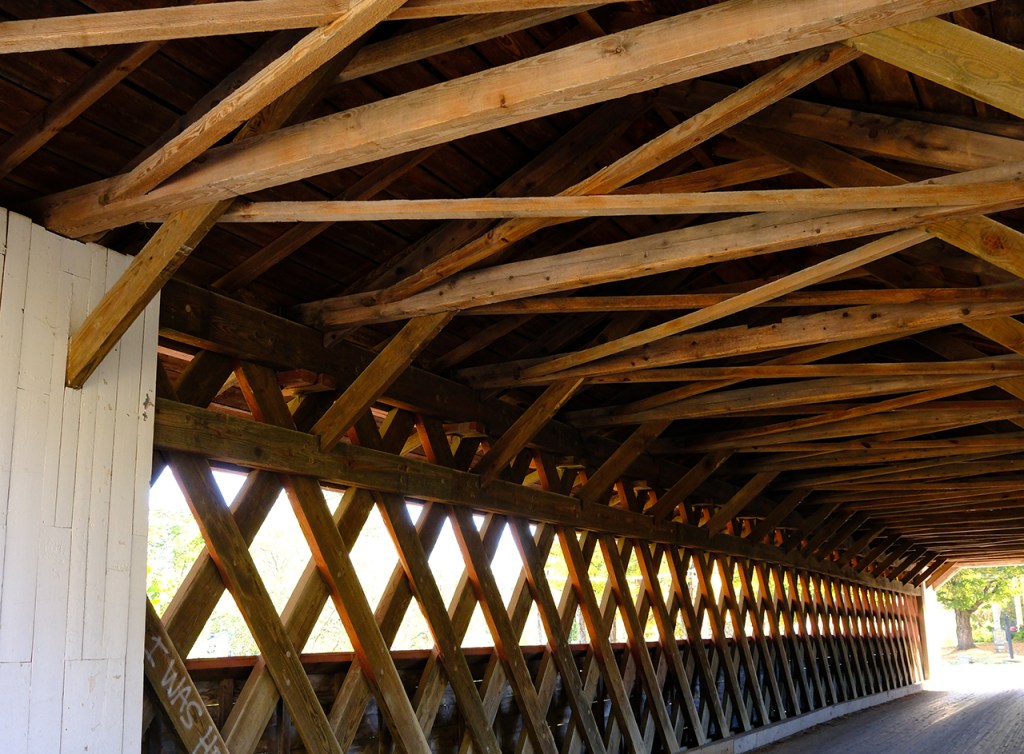
The Silk Road Covered bridge was built in 1840 by Benjamin Robinson Sears. (His son Charles F. Sears built the Paper Mill Covered Bridge that is nearby.) This bridge is a single-span Town Lattice Truss design spanning 88 feet long and 19 feet wide, with 15 foot roadway.
The bridge was repaired in 1952 and then restored in 1991 by The Vermont Agency of Transportation under engineer Gilbert Newbury. There were many craftsman involved in the rebuild including Brian Toomey who made 950 Trunnels. Trunnels are long dowels, or posts, that are usually made on a lathe. Toomey figured out how to make them on a table saw, making them straight with a beveled square head. These trunnels were then pounded into place by hand by the bridge builders. (Bennington Banner, Wed, Nov 20, 1991 · Page 12.) It also underwent repairs in 2011 after flood damage from Hurricane Irene.
The bridge’s original name was Locus Grove Bridge. It was then named the Robinson bridge after Benjamin Sears’ Grandfather Col. Samuel Robinson who lived nearby. The Robinson home was then purchased by James Silk and eventually the bridge’s name changed to Silk. (Bennington Banner, Fri, Apr 1, 2005 – Page 10.)
If you visit this bridge, be careful of cars. There is a lot of traffic and the cars drive through it pretty fast.
About Henry Covered Bridge
According to the National Historic Places nomination form, the Henry Covered Bridge was built sometime between 1830-40. (It is also known as the Burt Henry covered Bridge.)
The bridge is 121 feet long and 18.5 feet wide, with a 15-foot roadway, and is a Town Lattice Truss design. In 1866, the bridge was strengthened to accommodate for heavy wagon loads of iron by adding two layers of lattice trusses to the original single lattice trusses, making it a triple lattice design. The bridge was completely rebuilt in 1989 by Blow & Cote Inc. They specialize in reconstructing covered bridges, taking them apart piece by piece and then reassembling them.
Cars regularly drive through this bridge as well, but it seems to be a little out of the way with less traffic. On one side there is a small park to have a picnic, and then on the other side you’ll see the historic Henry House, built in 1769 by Elnathan Henry who bought the land from James Breckenridge. The Henry House is one of Vermont’s oldest houses and is currently a wedding event venue.


Links
- Vermont Covered Bridge Society
- Covered Bridges of Bennington, VT
- Silk Road Covered Bridge Wikipedia Page
- Silk Road Covered Bridge National Historic Places Nomination Form
- Burt Henry Covered Bridge Wikipedia Page
- Burt Henry Covered Bridge National History Places Nomination Form
- Covered Wooden Bridges by John Spargo (book)

Leave a comment